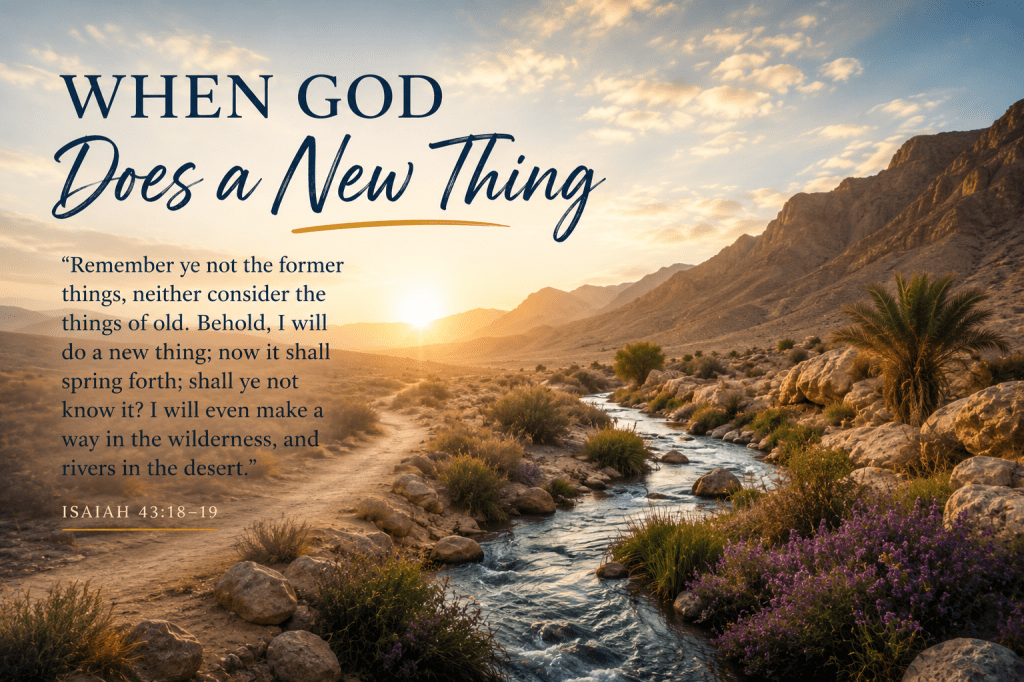
“Remember ye not the former things, neither consider the things of old. Behold, I will do a new thing; now it shall spring forth; shall ye not know it? I will even make a way in the wilderness, and rivers in the desert.” — Isaiah 43:18–19, Inspired Version
The past has a remarkable power over the human mind. We carry memories of what has been done to us, what we have done ourselves, what we lost, and what we once hoped life might become. Even our happiest memories can hold us back when we begin to believe that God’s finest work must always resemble something He did before.
Yet through Isaiah, the Lord calls His people to lift their eyes from what has been and recognise what He is doing now.
“Remember ye not the former things” does not mean that memory is wrong or that the past has no value. Scripture repeatedly calls us to remember God’s faithfulness. The warning is against becoming so fixed upon former things that we no longer recognise present grace. The past may instruct us, but it must not imprison us. It may explain where we have been, but it does not have the authority to decide where God may lead us next.
We often cling to yesterday in several ways. We replay old failures until they become an identity. We revisit old wounds until pain becomes a familiar home. We may even cling to former blessings, expecting God to work today exactly as He worked before. In each case, our attention becomes turned backwards.
God, however, declares, “Behold, I will do a new thing.”
That word behold is a call to attention. We are being asked to look carefully, because divine activity may begin quietly. A new work of God does not always arrive with spectacle. It may first appear as a changed desire, a softened attitude, a small opening, or the courage to take one faithful step. The new thing may already be springing forth before we have learned how to name it.
This is why spiritual attentiveness matters. A hurried and distracted life can easily miss what God is beginning. We may pray for change while overlooking the first signs of it. We ask for a new path, yet dismiss the small act of obedience through which that path will open. God’s work often begins beneath the surface, much like a seed pushing upward through soil before anything green becomes visible.
The imagery of the wilderness and the desert gives this promise particular strength. These are places where human resources are limited. The wilderness offers no obvious road, and the desert appears unable to sustain life. They represent the seasons in which we cannot see how to move forward or where renewal could possibly come from.
God does not promise merely to remove every wilderness. He promises to make a way within it.
That distinction matters. We sometimes assume that God’s faithfulness will be proved by immediate escape. Yet He may instead guide us through the difficult place, giving direction one step at a time. The path may not exist until He creates it. What feels confusing to us is not confusing to Him.
He also promises rivers in the desert. The desert speaks of dryness, weariness, disappointment, and the apparent absence of fruit. A river in such a place is not simply comfort; it is life where life should not naturally be possible. God is able to sustain us in places that should have emptied us. He can renew faith after disappointment, restore tenderness after sorrow, and awaken purpose after a season of uncertainty.
Our responsibility is not to manufacture the new thing. It is to remain open to God.
That may require releasing the demand that the future resemble the past. It may mean surrendering an old label, expectation, resentment, or fear. We cannot fully receive what God is bringing while insisting upon holding everything that belongs to yesterday.
The ordered soul honours the past without living under its rule. It remembers the lessons, receives the mercy, and then turns forward. It trusts that the God who was faithful before has not exhausted His wisdom or His power.
There may be a wilderness before us. There may be places that feel dry and unpromising. Yet neither wilderness nor desert places the work of God beyond reach.
He still makes ways where none are visible.
He still brings rivers into barren ground.
And even now, something new may already be springing forth.
 Saints of the Restoration